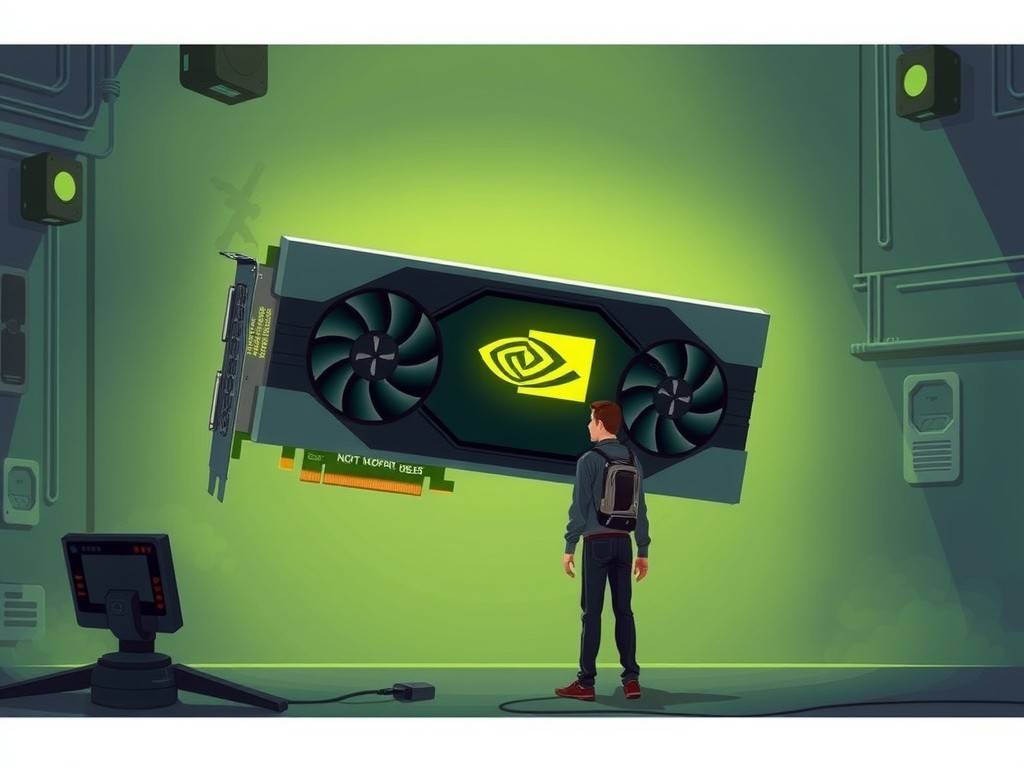
The world of artificial intelligence (AI) is rapidly evolving, and at its core lies the power of graphics processing units (GPUs). NVIDIA, a leading technology company, has been at the forefront of developing innovative GPUs that are revolutionizing the field of AI. As we look to the future, it's essential to understand what new NVIDIA GPUs mean for AI and how they will shape the industry. In this article, we'll delve into the world of AI and explore the exciting developments that NVIDIA's future GPUs will bring.
Key Concepts
Before we dive into the world of future NVIDIA GPUs, it's crucial to understand the fundamental concepts that drive AI. Artificial intelligence is a broad term that encompasses various subfields, including machine learning, natural language processing, and computer vision. At its core, AI is about developing algorithms that enable machines to learn from data and make decisions autonomously. The key to AI's success lies in its ability to process vast amounts of data quickly and efficiently, which is where GPUs come in.
GPUs were originally designed for graphics rendering, but their parallel processing capabilities make them ideal for AI computations. In recent years, NVIDIA has developed specialized GPUs, such as the Tesla V100 and V100S, specifically designed for AI and deep learning workloads. These GPUs have been instrumental in accelerating AI research and development, enabling scientists and engineers to train complex neural networks and develop sophisticated AI models.
The Role of NVIDIA in AI
NVIDIA has played a pivotal role in the development of AI, and its GPUs have been instrumental in driving innovation in the field. The company's CUDA platform, which allows developers to write code that runs on NVIDIA GPUs, has become a de facto standard for AI development. NVIDIA's GPUs have also been used in various AI applications, including self-driving cars, medical imaging, and natural language processing.
One of the key drivers of NVIDIA's success in AI has been its ability to develop specialized GPUs that meet the unique needs of AI workloads. The company's Volta and Tensor Cores, for example, are designed to accelerate specific AI computations, such as matrix multiplication and convolutional neural networks. These specialized cores have enabled NVIDIA's GPUs to achieve unprecedented levels of performance and efficiency, making them the go-to choice for AI researchers and developers.
Future NVIDIA GPUs and AI
So, what does the future hold for NVIDIA GPUs and AI? In recent years, the company has announced several new GPU architectures, including Ampere and Ada Lovelace, which promise to deliver even greater performance and efficiency. These new GPUs will be powered by advanced technologies, such as 3D stacked memory and improved power management, which will enable them to handle even more complex AI workloads.
One of the most exciting developments in NVIDIA's future GPUs is the introduction of the H100 GPU, which promises to deliver unprecedented levels of performance and efficiency. The H100 is designed to be the first GPU to achieve exaflop performance, which means it will be capable of performing over a billion billion calculations per second. This level of performance will enable researchers and developers to train even more complex AI models and develop new applications that were previously impossible.
Practical Implications
So, what does this mean for the practical applications of AI? The ability to train more complex AI models will have a significant impact on various industries, including healthcare, finance, and transportation. For example, in healthcare, AI models can be used to analyze medical images and identify diseases more accurately and quickly. In finance, AI models can be used to predict stock prices and detect anomalies in financial transactions.
In transportation, AI models can be used to develop more sophisticated self-driving cars that can navigate complex environments and make decisions in real-time. The ability to train more complex AI models will also enable researchers to develop new applications, such as AI-powered robots that can perform complex tasks and AI-powered chatbots that can understand natural language.
How it Works in Practice
To illustrate the impact of NVIDIA's future GPUs on AI, let's consider a hypothetical scenario. Imagine a team of researchers at a hospital who are working on developing an AI-powered system that can analyze medical images and identify diseases more accurately and quickly. The researchers are using NVIDIA's H100 GPU to train a complex AI model that can analyze thousands of medical images and identify patterns that are indicative of diseases.
Using NVIDIA's H100 GPU, the researchers are able to train the AI model in a matter of hours, rather than days or weeks. This is because the H100 GPU is capable of performing over a billion billion calculations per second, which enables it to handle even the most complex AI workloads. Once the AI model is trained, it can be used to analyze medical images and identify diseases more accurately and quickly, which can lead to better patient outcomes and improved healthcare.
FAQ
Q: What is the difference between NVIDIA's future GPUs and current GPUs?
A: NVIDIA's future GPUs, such as the H100, are designed to deliver unprecedented levels of performance and efficiency, making them ideal for complex AI workloads. They feature advanced technologies, such as 3D stacked memory and improved power management, which enable them to handle even more complex AI computations.
Q: How will NVIDIA's future GPUs impact the field of AI?
A: NVIDIA's future GPUs will enable researchers and developers to train even more complex AI models, which will lead to new applications and innovations in various industries, including healthcare, finance, and transportation.
Q: What are the practical implications of NVIDIA's future GPUs on AI?
A: The ability to train more complex AI models will have a significant impact on various industries, including healthcare, finance, and transportation. It will enable researchers to develop new applications, such as AI-powered robots and AI-powered chatbots, and improve patient outcomes and financial transactions.
Conclusion
In conclusion, NVIDIA's future GPUs will revolutionize the field of AI, enabling researchers and developers to train even more complex AI models and develop new applications. The introduction of the H100 GPU, which promises to deliver unprecedented levels of performance and efficiency, is a significant step forward in the development of AI. As we look to the future, it's clear that NVIDIA's future GPUs will have a profound impact on various industries and enable new innovations that were previously impossible.