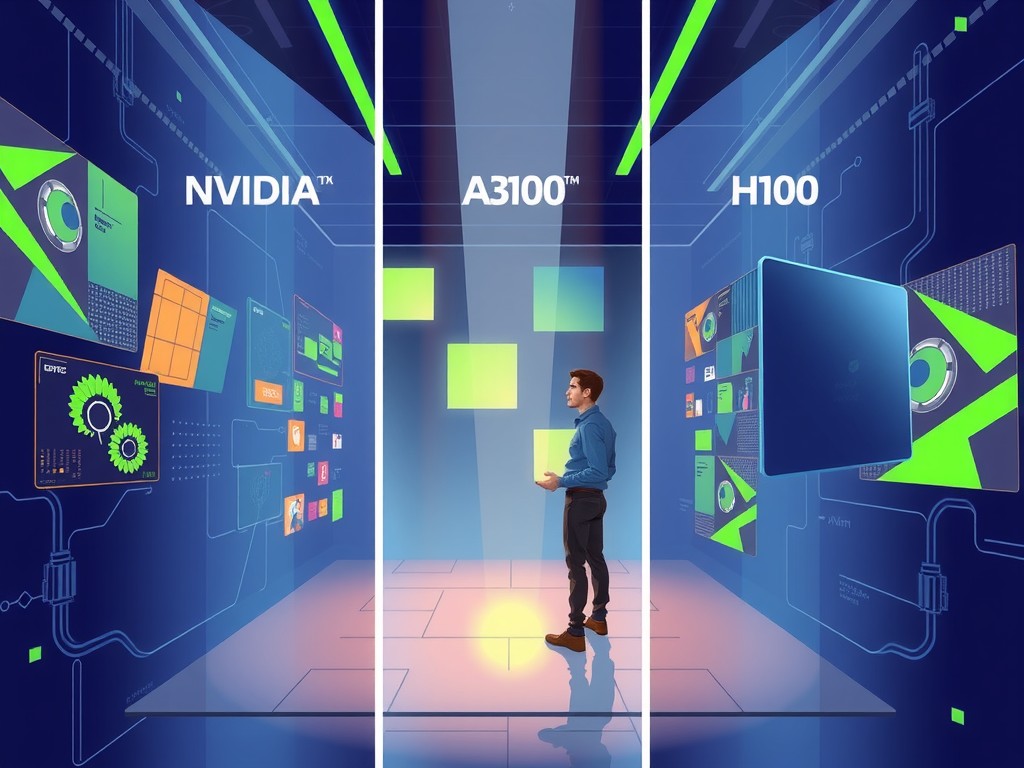
NVIDIA RTX vs A100 vs H100: Which GPU Is Best for AI?
Admin
NVIDIA GPUs for AI: Uncovering the Best Option
Introduction
The world of artificial intelligence (AI) has witnessed tremendous growth over the past decade, with numerous applications spanning various industries. From image recognition and natural language processing to predictive analytics and autonomous vehicles, AI has become an integral part of our lives. At the heart of this technological revolution lies the graphic processing unit (GPU), which plays a crucial role in accelerating AI computations. NVIDIA, a leading technology company, has been at the forefront of GPU innovation, releasing powerful models designed specifically for AI applications. In this article, we will delve into the world of NVIDIA GPUs and explore the differences between the RTX, A100, and H100 models, helping you determine which one is best suited for your AI needs.
Key Concepts
Before we dive into the specifics of each GPU model, it's essential to understand the underlying concepts and technologies that power them. AI computations often involve matrix operations, which are complex calculations that require massive parallel processing capabilities. This is where GPUs come into play, leveraging their parallel processing architecture to perform these calculations at incredible speeds. In the context of AI, GPUs are used for tasks such as neural network training, inference, and optimization. The NVIDIA GPU architecture is designed to optimize these tasks, with features like multi-GPU support, high-bandwidth memory, and advanced cooling systems.
Another crucial aspect of AI is the concept of deep learning, which refers to the use of neural networks with multiple layers to learn complex patterns in data. Deep learning models, such as convolutional neural networks (CNNs) and recurrent neural networks (RNNs), are widely used in AI applications, including image recognition, speech recognition, and natural language processing. The NVIDIA GPU models we'll be discussing are optimized for deep learning workloads, featuring advanced features like tensor cores, which accelerate matrix operations, and AI-enhanced graphics processing.
NVIDIA RTX: A Powerful Mid-Range Option
The NVIDIA RTX series is a line of GPUs designed for gaming and AI applications. The RTX models are built on the NVIDIA Turing architecture, which provides a significant boost in performance and efficiency compared to previous generations. The RTX series is ideal for AI developers who require a balance between performance and power consumption. With a range of models available, including the RTX 3060, RTX 3070, and RTX 3080, the RTX series offers a versatile solution for AI workloads.
The RTX models feature NVIDIA's Tensor Cores, which accelerate matrix operations and provide a significant boost in AI performance. Additionally, the RTX series supports multi-GPU configurations, allowing developers to scale their AI workloads and achieve even faster performance. In terms of power consumption, the RTX models are relatively efficient, making them suitable for data centers and cloud computing environments.
NVIDIA A100: A High-Performance Data Center GPU
The NVIDIA A100 is a high-performance GPU designed specifically for data center and cloud computing applications. Built on the NVIDIA Ampere architecture, the A100 features a significant increase in performance and efficiency compared to previous generations. The A100 is optimized for AI workloads, featuring advanced features like tensor cores, multi-GPU support, and high-bandwidth memory.
The A100 is designed for large-scale AI deployments, such as data centers and cloud computing environments. With a range of models available, including the A100 SXM4 and A100 PCIe, the A100 series offers a high-performance solution for AI workloads. In terms of power consumption, the A100 models are relatively high, but the increased performance and efficiency make them an attractive option for data center and cloud computing applications.
NVIDIA H100: The Future of AI Computing
The NVIDIA H100 is the latest addition to the NVIDIA GPU family, designed for the most demanding AI workloads. Built on the NVIDIA Hopper architecture, the H100 features a significant increase in performance and efficiency compared to previous generations. The H100 is optimized for large-scale AI deployments, featuring advanced features like tensor cores, multi-GPU support, and high-bandwidth memory.
The H100 is designed for applications that require the highest level of performance and efficiency, such as AI research, data analytics, and high-performance computing. With a range of models available, including the H100 SXM8 and H100 PCIe, the H100 series offers a cutting-edge solution for AI workloads. In terms of power consumption, the H100 models are relatively high, but the increased performance and efficiency make them an attractive option for the most demanding AI applications.
Practical Implications
The choice of NVIDIA GPU model has significant practical implications for AI developers and researchers. With the increasing complexity and demand for AI applications, the right GPU model can make all the difference in terms of performance, efficiency, and cost. The NVIDIA RTX series, for example, is ideal for developers who require a balance between performance and power consumption. The RTX models are relatively affordable and offer a versatile solution for AI workloads.
On the other hand, the NVIDIA A100 and H100 models are designed for large-scale AI deployments, such as data centers and cloud computing environments. These models offer a high-performance solution for AI workloads, but require a significant investment in terms of power consumption and cost. The choice of GPU model ultimately depends on the specific needs and requirements of the AI application.
How it Works in Practice
To illustrate the practical implications of choosing the right NVIDIA GPU model, let's consider a scenario where a researcher wants to train a deep learning model for image recognition. The researcher requires a high-performance GPU to accelerate the training process and achieve state-of-the-art results.
In this scenario, the researcher might choose the NVIDIA A100 or H100 model, which offer the highest level of performance and efficiency for AI workloads. With the A100 or H100, the researcher can train the deep learning model quickly and efficiently, achieving state-of-the-art results.
On the other hand, if the researcher requires a more affordable solution, they might choose the NVIDIA RTX model. The RTX series offers a balance between performance and power consumption, making it an attractive option for developers who require a versatile solution for AI workloads.
FAQ
Q: What is the difference between the NVIDIA RTX, A100, and H100 models?
A: The NVIDIA RTX series is designed for gaming and AI applications, offering a balance between performance and power consumption. The A100 and H100 models are designed for large-scale AI deployments, such as data centers and cloud computing environments, offering the highest level of performance and efficiency.
Q: Which NVIDIA GPU model is best suited for AI workloads?
A: The choice of NVIDIA GPU model depends on the specific needs and requirements of the AI application. The RTX series is ideal for developers who require a balance between performance and power consumption. The A100 and H100 models are designed for large-scale AI deployments and offer the highest level of performance and efficiency.
Q: What is the power consumption of the NVIDIA A100 and H100 models?
A: The NVIDIA A100 and H100 models have relatively high power consumption, but the increased performance and efficiency make them an attractive option for data center and cloud computing applications.
Q: Can I use the NVIDIA RTX model for large-scale AI deployments?
A: While the NVIDIA RTX series offers a versatile solution for AI workloads, it may not be the best option for large-scale AI deployments. The RTX series is designed for gaming and AI applications, whereas the A100 and H100 models are designed for large-scale AI deployments.
Conclusion
The choice of NVIDIA GPU model has significant practical implications for AI developers and researchers. With the increasing complexity and demand for AI applications, the right GPU model can make all the difference in terms of performance, efficiency, and cost. The NVIDIA RTX series, A100, and H100 models offer a range of options for AI workloads, from balanced performance and power consumption to high-performance and efficiency.
Ultimately, the choice of GPU model depends on the specific needs and requirements of the AI application. By understanding the key concepts, practical implications, and how it works in practice, developers and researchers can make informed decisions when choosing the right NVIDIA GPU model for their AI needs.